Ever noticed how quickly your confidence drops after something small goes wrong? You miss a detail in an email, forget what you were about to say, or stumble slightly in a conversation. These are all small events and nothing dramatic has happened, and yet internally something shifts. A sentence appears.
“I’m so bad at this.”
“I should be better by now.”
“Everyone else handles this better than I do.”
In that moment, your self-confidence does not disappear but it is knocked just a little. The sentence you form about the situation quietly lowers your sense of capability, and once that sentence settles in, your behavior begins to change. This is how negative self-talk works.
Most people assume confidence collapses after major failures. In reality, it usually erodes gradually through repeated internal commentary. The language might sound subtle and reasonable at first. You might tell yourself, “I’m not ready,” or “This isn’t really my strength,” or “I’m just not that type of person.” These phrases do not sound dramatic, but when they are repeated often enough, they create a pattern, and patterns shape behavior.
How The Pattern Forms
An opportunity appears but before you can act on it, a sentence forms in your mind. It might be, “I’ll embarrass myself,” or “I’m not experienced enough,” or “I’m already behind.” That sentence produces an emotional reaction such as anxiety, hesitation, or self-doubt. That emotion then influences what you do next. You delay responding or you speak less. You decline the opportunity or you hold back.
The outcome that follows often confirms the original sentence. If you avoid contributing, you never gather evidence that you are capable. If you decline the opportunity, you never see how you would have handled it. The original thought now feels validated. You think, “See? I knew I wasn’t ready.” But what actually happened was that the sentence influenced the behavior, and the behavior shaped the result.
My life was full of missed opportunities because my self-talk would just not let me believe I was good enough to make them work. I had to constantly work on my own self-confidence and in particular my self-talk before I could accept that if I was being asked, I was good enough.
This is how negative self-talk silences confidence. It doesn't happen loudly. It happens through repetition.
What Happens To Taking Action
Your desire to get things done and take action, is also affected in the same way. People often say they struggle with getting things done but this desire rarely disappears on its own. It follows belief.
If your internal sentence says, “This won’t work,” or “I’m not disciplined,” or “There’s no point trying,” then your desire to take action naturally declines because it is difficult to feel energized about something you have already decided will fail. Negative self-talk has stopped you before action even began. If you expect failure, you naturally reduce your effort because you assume the effort won't matter.
On the other hand, when the sentence shifts to something manageable like, “Let’s try one step,” or “I can adjust as I go,” or “This might improve with practice,” your desire to take action has room to return. These sentences do not guarantee success, but they allow movement, and movement creates momentum.
Where I Nearly Talked Myself Out Of It
Working freelance means I am the only person responsible for how much I charge a potential client and I put off raising my own rates for years. The sentence running underneath it was “I’m not really the type of person who asks for that.” Not “I can’t justify it” because I could have, easily. Just that quiet identity line, repeated so often it stopped sounding like an opinion. What actually moved me was swapping it for something smaller and truer: “I can send one email and see what happens.” That sentence didn’t require me to feel confident. It only required one action. The email got sent and nothing terrible happened. I simply negotiated a new rate.
That’s the only reason the sentence changed not because I felt ready, but because I took a simple step and that gave me new evidence.
Why Exaggeration Makes It Worse
Another reason negative self-talk is so powerful is because of exaggeration. Harsh internal language often includes global words such as always, never, everything, nothing, and ruined. You might say, “I always mess this up,” or “This ruined everything,” or “I never get this right.” These words inflate the situation instantly.
When the language is inflated, the emotion becomes inflated as well. The body responds as if the problem is larger than it actually is.
If you replace “This is a disaster” with “This is frustrating,” the emotional response changes. The situation may still be uncomfortable, but it becomes manageable. Manageable emotions lead to better decisions. Lowering the scale of the language lowers the intensity of the feeling, and when feelings are steadier, behavior improves.
The Confidence Loop
Confidence grows through a loop. First, you interpret a situation in manageable terms. Then you take action. That action creates evidence. Evidence reinforces belief. Belief strengthens confidence. Negative self-talk interrupts this loop at the very beginning.
If the interpretation is harsh or exaggerated, action decreases. Without action, no new evidence is created. Without evidence, confidence remains low.
This is why steady, accurate language matters more than exaggerated positivity. If your internal dialogue jumps from criticism to unrealistic praise, it will not feel believable. Saying, “I’m amazing at everything,” does not help if you do not believe it. But saying, “I can improve this,” or “I can handle one step,” often feels realistic. Realistic sentences support realistic action.
Consider a simple example. You are thinking about speaking up in a meeting. If your internal sentence is, “I’ll sound stupid,” anxiety rises and you stay silent. You leave the meeting with no new evidence of competence. The sentence remains intact. Now imagine the internal sentence is, “I’ll make one clear point.” You may still feel nervous, but the action becomes possible. You speak once and you survive the experience, maybe you even contribute something useful. That small action produces evidence. Repeated enough times, that evidence reshapes your internal dialogue.
When the sentence changes from “I can’t do this” to “This will take effort, but I can start,” the task no longer feels impossible. It feels demanding but manageable and that difference can determine whether you begin.
Where To Start
If you want to improve your self-talk to help raise your self-confidence, begin by listening for the sentence that weakens you most often. Write it down exactly as you say it. Then examine the wording carefully. Is it exaggerated? Is it global? Is it labelling you as a person rather than describing a behavior?
Replace it with something accurate and steady, then repeat that version consistently and you will find your confidence grows because you change the language that was quietly undermining you.
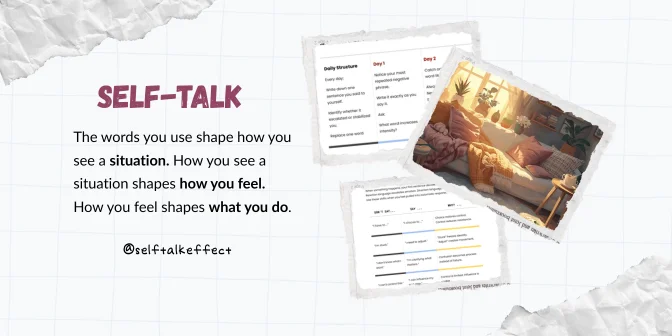
The Self-Talk Effect guide breaks this process down step by step. It will show you how to notice the sentence, lower the intensity, and repeat the steadier version until it becomes natural.
Always remember that confidence builds through repetition and repetition begins with the sentence you choose.