There was a time I thought I could talk myself into becoming more extroverted. I thought that if I stood on enough stages and talked to enough people, eventually I would become someone who felt completely at home doing it. Back in the early 2000s, I was running Inspirational Guidance with the dream of becoming a motivational speaker. I believed that pushing myself out of my comfort zone would eventually make speaking feel easier.
Some of it did and some of it really did not. What eventually worked was to manage my self-talk and have a system for doing that because public speaking nerves are rarely just about standing in front of a room. There is usually a whole conversation happening before you even say the first word. I used to say things like:
I am going to forget what I want to say.
Everyone is going to notice that I am nervous.
What if I make a fool of myself?
What if they think I am not good enough?
Those sentences can turn a perfectly manageable speaking opportunity into something that feels much bigger and just cause overall feelings of dread when it comes to public sepaking, but that is where self-talk becomes interesting.
Your nerves are only part of the story
Getting nervous before speaking is common for the majority of us. Experiencing your heart beating faster and your hands feeling clammy or different. becoming very aware of your breathing, your voice, your face, and believing you know what everyone in the room is thinking. Then to make it all worse you add a sentence that gives this physical reaction meaning. You feel your heart beating faster and think:
“I am panicking.”
You feel your body tense up and you think:
“I am too nervous to do this.”
You forget one word during rehearsal and think:
“I am going to forget everything when I get up there.
Yes, the physical sensation is real but what I encourage you to look at is whether the conclusion you attach to it is real, or something else.
This is the distinction at the heart of The Self-Talk Effect. Something happens, you describe it to yourself, that description influences your emotional response, and your emotional response influences what you do next.
The sentence before the speech matters
Research into public speaking has found that the kind of self-talk people use is related to how much public speaking anxiety they report. One study found that self-critical and social-assessing self-talk were associated with higher public speaking anxiety, while self-reinforcing self-talk showed the opposite relationship.
Another study looked specifically at self-talk during public speaking and found that self-managing self-talk had a direct positive relationship with aspects of speech performance, while frequent self-critical self-talk contributed substantially to the experience of speech-related anxiety.
That distinction is useful because there is a difference between saying:
“Everyone is judging me.”
and:
“Focus on the next point.”
The first sentence sends your attention outward toward imagined judgment and the second gives you something to do. It is that kind of shift The Self-Talk Effect is interested in teaching.
Your brain will fill in the gaps
Public speaking contains a lot of uncertainty and you won't know exactly what the audience is thinking. You can't know whether somebody in the second row is looking serious because they dislike your presentation, because they are tired, or because they are concentrating (trust me I have a "this is very interesting serious face that often gets misjudged!) and you can't always tell if a pause in the room means everyone is bored or everyone is listening.
However, your mind will happily fill in the blanks.
You look at a serious face and think:
“They are not impressed.”
You lose your place for a second and think:
“I have completely messed this up.”
Someone looks at their phone and you think:
“Nobody is listening.”
The event is one thing and the sentence you create about the event is another.
This is why the question “What am I saying to myself right now?” is so useful. It brings the sentence into view instead of allowing it to run quietly in the background and once you hear it, you can work with it.
Give yourself an instruction
This is the part that I think is particularly useful before public speaking. What you want to do once you have steadied yourself by asking "what am I saying to myself right now?" is to then give yourself direction using short, direct instructions because they answer a very practical question: what happens next?
Before you get up to speak you can stead yourself by saving sentences like:
“Look at one person.”
“Focus on the next point.”
“Speak slowly.”
“Stay with the message.”
These are very different from a sentence like: I need to stop being nervous or I need to make a good impression - that describe an outcome and won't help at all.
An instruction gives you something to do and that matters because attention can become part of the problem when you are nervous. Research on public speaking anxiety has found that highly anxious speakers can become more self-focused and pay less attention to their environment, with this self-focused attention associated with poorer speaking performance. A simple instruction can give your attention somewhere useful to go.
What to say when the nerves appear
Imagine you are standing at the side of the room waiting to be introduced and you have the usual pre-speech gitters. Your heart is beating faster, maybe your mouth feels a little dry. You look at the audience and your usual old sentence appears:
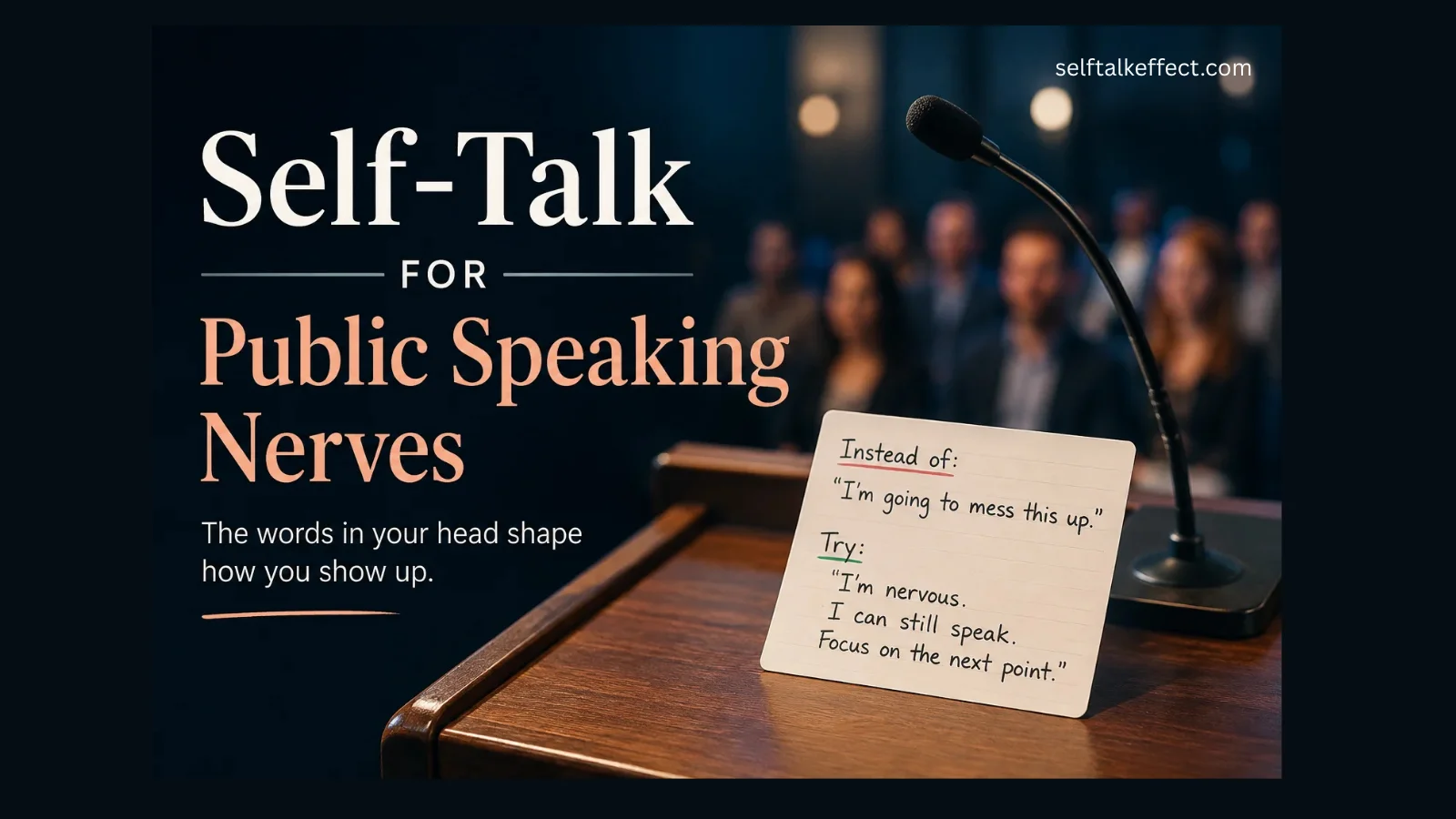
“Oh God. I am really nervous. I am going to mess this up.”
You could spend the next two minutes arguing with that thought or you could simply change the sentence.
“I am nervous. That is okay. I know what I want to say.”
Then:
“Take the first sentence and speak slowly.”
You get on stage, say hello and say the first sentence. That is the entire process.
- Notice.
- Refine.
- Give yourself direction.
- Act.
The goal is not to make yourself feel perfectly calm before you speak because that may never happen, no, the goal is to stop the internal commentary from taking over the moment.
What about the fear of forgetting what to say?
This is one of the most common public speaking worries and it can become self-fulfilling in a very ordinary way because you become so focused on remembering every word that you stop paying attention to what you are actually saying. Then you lose your place and that's where panic can really set it and the sentence appears:
“I knew this would happen.”
Which increases the pressure, making it harder to think, which in turn makes finding your place harder too. The key thing to remember here and something I always told myself is that no one knows what I was going to say anyway, so if things end up being said a little out of order or if you miss something out, does it really matter? Obviously, the answer will depend on the talk you are giving but most times it probably won't so why worry?
The best thing to do is focus on something specific:
“I do not need every word. I need the next point.”
Then:
“What is the next thing I want them to understand?”
That question gives you somewhere to go and you can continue. It is easy enough to then return to anything that you might have missed out with a simple "before I finish..." especially if it is important.
The Self-Talk Effect materials make this same distinction between questions that keep you inside the problem and questions that create direction because you don't have to remember everything at once, you only need to know what comes next.
Try this before your next presentation
Before your next speaking engagement, spend five minutes listening to your own self-talk and write down the sentences exactly as they appear without editing.
You might find:
“I am going to forget everything.”
“They are going to think I am boring.”
“I hate public speaking.”
“I am terrible at presentations.”
Now look at the wording.
Is there an always, never, everyone, or another word that is making the situation larger?
Is the sentence describing what is happening, or turning it into a statement about who you are?
Once you answer those questions, work on refining it:
“I am terrible at presentations.”
becomes:
“Presenting is something I am still developing.”
“I am going to forget everything.”
becomes:
“I may lose my place. I can pause and continue.”
“Everyone is going to judge me.”
becomes:
“I cannot know what everyone is thinking. I can focus on what I came to say.”
Then choose one short instruction.
“Slow down.”
“Take the next point.”
“Stay with the message.”
Keep your sentence simple and restrict it to just one. Say it out loud once or twice before you begin and you will find that will make public speaking a much more enjoyable experience.
Questions to ask yourself
- What is the exact sentence I usually say to myself before speaking?
- Does that sentence describe what is happening, or predict something I cannot know?
- Am I using words such as always, never, everyone, or everything?
- Am I turning a behavior into an identity statement?
- What would a more accurate version of the sentence sound like?
- What short instruction would help me direct my attention?
- What is the next thing I actually need to do?
If it helps, you can write these down before a presentation and keep them somewhere you can see them.
The sentence you use does not have to make you fearless
You may still feel nervous and have some or all of the common symptoms of that already mentions and you may still feel that familiar moment just before you stand up when every part of you would quite happily vote for staying in your seat. I know that feeling and the useful shift is smaller than becoming fearless, it is as simple as this:
- You notice the sentence.
- You make it more accurate.
- Then you tell yourself what to do next.
Then you speak, and your nerves can come along for the ride, but they will no longer be the ones holding the microphone.
Public speaking nerves become harder to manage when your self-talk turns a physical reaction into a prediction of failure. A steadier sentence gives you room to respond, and a clear instruction gives that response somewhere to go.
The next time you feel the nerves rising, listen for the sentence because now you understand that is where you can begin.
Your next step
If public speaking nerves are part of a wider pattern of negative or self-critical self-talk, The Self-Talk Effect: Understanding Negative Self-Talk goes deeper into the process of noticing the sentence, refining it, giving yourself direction, and taking the next action. The method is designed around everyday situations where the words in your head influence what happens next.
References
- Shi, X., Brinthaupt, T. M., & McCree, M. (2017). Understanding the Influence of Self-Critical, Self-Managing, and Social-Assessing Self-Talk on Performance Outcomes in a Public Speaking Context. Communication Quarterly, 36(4), 356-378. Research paper.
- Shi, X., Brinthaupt, T. M., & McCree, M. (2015). The relationship of self-talk frequency to communication apprehension and public speaking anxiety. Personality and Individual Differences, 75, 125-129. Research paper.
- Shadinger, D., Katsion, J., Myllykangas, S., & Case, D. (2020). The Impact of a Positive, Self-Talk Statement on Public Speaking Anxiety. College Teaching, 68(1), 5-11. Research paper.
- Gallego, A., McHugh, L., & others. (2022). Measuring Public Speaking Anxiety: Self-report, behavioral, and physiological. Assessment, 29. Research article.
- Hatzigeorgiadis, A., Zourbanos, N., Galanis, E., & Theodorakis, Y. (2011). Self-Talk and Sports Performance: A Meta-Analysis. Perspectives on Psychological Science, 6(4), 348-356. Research article.