Something I have come to understand in two decades of working in personal development is that most people don’t need more advice.
They already know they should start
They know they should finish.
They know scrolling won’t build their future.
They know avoidance feels worse later.
Knowledge is rarely the issue. The issue is the sentence they say to themselves. The one that runs quietly in the background. The one that says:
“It’s too late.”
“I’ll do it tomorrow.”
“I’m not ready.”
“This always happens.”
Those sentences are ordinary language that builds ordinary patterns, and ordinary patterns repeated long enough become behavior. Tell yourself you’re clumsy often enough, and “clumsy” stops being a passing thought, it becomes part of who you think you are.
The Self-Talk Effect exists because your words are steering you, even when you’re not paying attention.
You’ve probably heard some version of the phrase: “be careful what you tell yourself, because you are listening.” It’s true, and it’s more powerful than it sounds. Your inner dialogue can stop you in your tracks without you noticing it happening. You assume it’s just “the way things are.” It isn’t. It’s the effect of your own words.
You don’t act first. You explain it to yourself first – and that internal voice sets the tone for everything that follows. It’s not the event. It’s what you tell yourself about the event – the meaning you give it.
The Self-Talk Effect helps you notice that meaning. Once you can hear the sentence clearly, you can question it. Once you question it, you can choose something steadier.
Why This Matters To Me
I didn’t arrive at this work through a textbook. I grew up learning that the safest thing to be was quiet, which meant being agreeable, easy, no trouble. Somewhere in there, that turned into a sentence I carried for years: that I was “too shy,” that speaking up wasn’t really “me.” I spent the best part of two decades collecting books, courses and workshops, trying to fix a version of myself that didn’t actually need fixing. What needed to change wasn’t me. It was the sentence running underneath everything I did.
The moment it became impossible to ignore was becoming a mother. I caught myself narrating my own limits out loud. Saying things like “I’m just not good in front of people,” and “that’s not something I do.” I realized my daughter will end up listening to those words if I didn't change them and that was the moment “I’ll work on this someday” became “enough, now.”
The Self-Talk Effect is what I built from getting that voice under control sentence by sentence, in ordinary situations, over real years.
Why It Can Feel Hard to See
Here’s the tricky part. Your inner dialogue feels like you. It doesn’t feel like something you can edit. It feels like truth.
When you say “I’m terrible at this,” it doesn’t feel like commentary. It feels like fact.
When you say “I can’t handle this,” it feels accurate, because in that moment it feels real.
But language does something to your experience most people don’t realise. It exaggerates, generalizes, labels and predicts. That isn’t a flaw it's just the way we see and handle the world. The problem starts when those quick shortcuts become permanent conclusions.
If you repeat “I always quit,” you find that you do actually quit things that you start. If you repeat “this is overwhelming,” you find yourself responding with real, physical stress. Think the same thought often enough and it starts to feel automatic. When it feels automatic, you act on it without noticing. That’s how patterns are built.
So no, it isn’t “just a thought.” It’s practice.
The Self-Talk Effect exists because many people are practicing the wrong script, then wondering why they keep getting the same result.
How Questions Play A Part
I wrote The Self-Talk Effect because I believe a small question can go a long way towards helping us get the answers we need to support changing how we behave.
“What am I telling myself right now?”
That question alone can shift how you feel in the moment. Questions reopen what you believe to be true. They invite curiosity and support growth. Statements, especially negative ones, tend to shut that down. “This is a disaster” closes you off, compared with “this needs adjustment,” which opens space to explore further.
Same situation, two different outlooks, two different emotional responses, two different behaviors. That’s the effect.
How The Self-Talk Effect Works
The Self-Talk Effect is grounded in three core steps:
Awareness. Replacement. Repetition.
First, you notice the sentence before it runs you. You start catching yourself in real time – realizing what you’ve been saying without noticing.
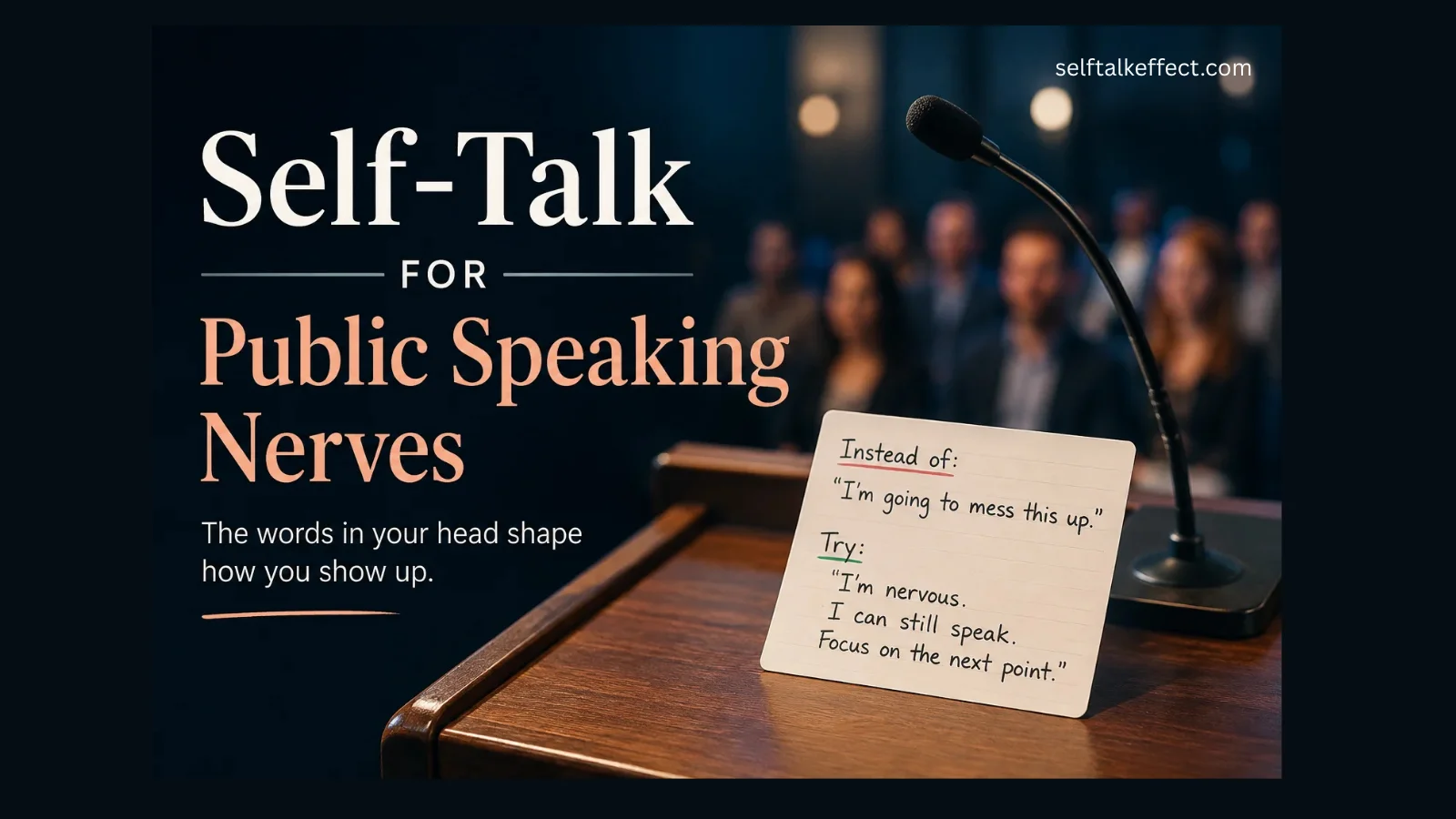
Second, you replace one word, a phrase, or choose something different. “I’m terrible at this” becomes “this needs practice.” “I have to” becomes “I choose to.” “I’m stuck” becomes “I need to adjust.”
Third, you repeat the steadier version until it feels natural. At first you’ll catch yourself saying the old phrase. Then you’ll correct it. Eventually the new sentence becomes your default.
This works because when something feels like your choice, you’re more likely to follow through on it.
Everyday Examples
It’s Saturday and you want to watch something, but you also said you’d finish something important.
Your inner voice says: “I can’t be bothered with this right now, I want to watch TV.”
That sentence is doing more than you think. It makes the task feel less important, so you stop moving towards getting it done. It tells your brain “no rush,” and your brain happily agrees. You’ve just given yourself permission to let it slide.
Now replace it with: “One small action still counts. Just work on it for 15 minutes.”
That feels manageable and specific, which helps you get started and once you start, 15 minutes can easily turns into more.
Here’s another example. You wake up and think: “I have too much to do.” Your body tightens. Your mind scans everything at once. You feel “stressed out.”
Instead of going with what might genuinely be a fact - you do have a lot to do - try replacing that statement with a question: “What’s the next step?”
Suddenly what felt overwhelming feels lighter. The whole day shrinks into one action. Complete that. Then move to the next. Focusing on one step at a time is what makes consistency possible.
A Quick Reminder
The Self-Talk Effect exists because what you say comes before what you do.
When you understand that, you realize you can adjust what you say so it supports what you actually want to do. You act after you speak to yourself, and small shifts in how you speak change what you do. Keep repeating those small shifts and they build into consistent results.
Most people are repeating a sentence that keeps slowing them down. You’re already talking to yourself all day. The only real question is: is that voice helping you move, or helping you stay stuck?
All it takes is a willingness to become more deliberate with the words that shape what you say and do, or don’t say and do, in some cases.
Your Next Step
Today, listen to your internal dialogue and catch one sentence. Then ask yourself: is this sentence pushing me forward or holding me still?
If you choose to change it, repeat the steadier version twice. Then act once.
Small questions. Better decisions. Act. Repeat.
That’s where this begins, and if you want to go deeper into the process, the full Self-Talk Effect Guide walks you through it step by step.