Self-talk is the quiet voice running in the background of your day. It shapes how you interpret situations, how you feel about yourself, and what you decide to do next. Most people don’t notice it until it starts hurting their confidence, mood, or momentum. This page will help you understand what self-talk really is, how it creates patterns you didn’t choose, and how to change it in practical, repeatable ways.
Take Control Of Your Self-Talk
What It Is, How It Harms, and How to Change It

Featured Articles
What Self-Talk Really Is and Why It Matters
Understand the internal commentary shaping your daily decisions.
Continue Reading →
How Negative Self-Talk Silences Confidence and Motivation
See how small repeated sentences erode momentum.
Continue Reading →
Examples of Negative Self-Talk You Don’t Notice
Recognize the patterns hiding in plain sight.
Continue Reading →
What sentence are you repeating today? Is it steady or exaggerated? Is it accurate or inflated? You do not need to silence your thoughts. You need to adjust the wording. That is where behavior begins to change.
What Is The Self-Talk Effect?
The Self-Talk Effect is simple: What you repeatedly say to yourself shapes what you repeatedly do.
You interpret something. You feel something. You act from that feeling. You reinforce an identity. Most of this happens automatically. If your internal sentence is: “I always mess this up.” You hesitate. If the sentence is: “I’ll handle this step by step.” You move. The sentence matters. Self-talk is not just thinking. It is direction. It is the difference between spiraling and steady. Between reacting and choosing.
Your brain gets stronger at whatever you repeat. If you repeat harsh sentences, self-doubt feels natural. If you repeat steady sentences, action feels easier. Language shapes interpretation. Interpretation shapes emotion. Emotion shapes behavior. Change the sentence and you change the pattern. Not overnight. But consistently. And consistency is what builds confidence.
Step One
Notice the Sentence Running Your Behavior
Catch what you are actually saying to yourself in real time.
Step Two
Lower the Intensity of the Language
Replace “always,” and “never,” with something accurate.
Learn more →
Step Three
Pause To Interrupt the Spiral Early
Pause before emotion takes over the story.
Learn more →
Step Four
Use Six-Word Self-Talk Shifts
Short, steady phrases that redirect your thinking fast.
Learn 6 Words →
Step Five
Ask Questions
You may not notice them, but questions are always present.
More On Questions →
Step Six
Repeat Until It Feels Normal
Repetition turns intention into identity.
About Repetition →
What Happens When You Practice Positive Self-Talk Daily
Change the sentence, and you change the direction.
Negative Self-talk does not change into something more positive or intentional in one dramatic moment. It changes in repetition. At first, you simply notice more. You catch the sentence as it leaves your mouth or crosses your mind. That alone creates space. Then something subtle shifts. Your mood becomes less reactive. Not perfectly calm. Just less extreme. Instead of spiralling quickly, you pause earlier. You choose a steadier interpretation. That steadier interpretation creates a steadier feeling.
Over time, your decisions improve. Not because you forced confidence, but because you removed unnecessary drama. When your internal language is measured, your actions follow that tone. You send the message. You take the step. You respond instead of react. Confidence grows from evidence and evidence comes from repeated action. When your self-talk supports small, consistent behaviour, results begin to build up and grow. That growth builds identity. You start to see yourself as someone who handles things instead of someone who collapses under them.
This is not about becoming positive. It is about becoming precise. When your words are accurate instead of exaggerated, your nervous system settles. When your nervous system settles, your choices improve.
Most people do not lack knowledge. They lack awareness and interruption. The six steps above are awareness tools. When you use them every day, your emotions become steadier, your actions become more consistent, and consistent actions produce better results over time. It all starts with self-talk.
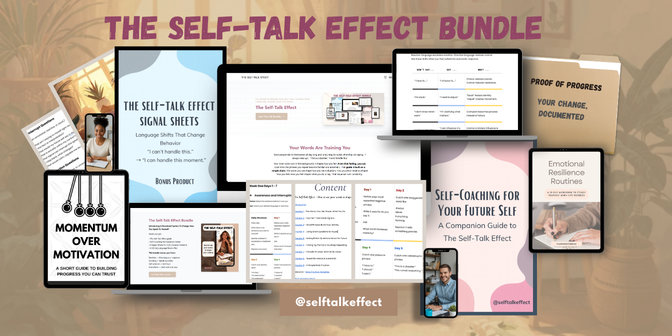
If you are interested in going deeper into the process, the Self-Talk Effect Guide and Bundle walks you through it step-by-step.
Self-Talk FAQs
Confidence grows from evidence. If your internal sentence predicts failure, you hesitate. Hesitation reduces action. Reduced action reduces evidence. Shift the sentence to something manageable like “Handle this step.” Then take one action. Repeated action builds proof. Proof builds confidence.
Fast reactions usually follow fast interpretations. You decide what something means and respond emotionally before checking the story. Insert one pause. Ask, “What else could this mean?” That question slows the loop. Slower interpretation leads to steadier response.
No. This is not about pretending everything is fine. It is about accurate language. Accurate language keeps emotion steady.
The brain prefers certainty. Predicting the worst creates a strange sense of control because it prepares you emotionally. The problem is that constant worst-case thinking increases anxiety and avoidance. Often the language includes words like always, never, ruined, disaster. These inflate the prediction. Replace catastrophic language with precise wording and emotional intensity drops.
Because thoughts feel automatic. They show up quickly and sound confident. But not every thought is a fact. Many are interpretations shaped by habit. Start asking: Is this fact or interpretation? That small shift creates distance. Distance reduces emotional intensity. Reduced intensity improves decision-making.
You do not replace criticism with unrealistic praise. You replace exaggeration with accuracy. Instead of “I’m terrible at this,” try “That didn’t go well.” Accuracy feels believable. When a replacement sentence feels believable, it does not feel fake. The goal is steadiness, not forced positivity.
That sentence usually did not appear overnight. It developed through repetition. It may have started with comparison, criticism, or one difficult experience that you replayed often. When a sentence is repeated enough, it begins to feel factual. The goal is not to force positive thinking. It is to examine the wording. Is “not good enough” specific? Or is it global and exaggerated? Narrow the language and you narrow the emotional impact.
You stop it in stages, not instantly. First, you notice the exact sentence. Second, you lower the intensity of the wording. Third, you replace one phrase at a time. Trying to silence all negative thoughts at once creates more frustration. Instead, catch one recurring line and adjust it. Over time, repetition of a steadier sentence reduces how automatic the negative one feels.
It depends on repetition. Patterns built over years shift gradually. But small changes feel noticeable quickly. One replaced sentence can change one moment. Repeated daily, that moment becomes a pattern. Consistency matters more than intensity.
Changing one sentence will not change everything instantly. But repeated internal language shapes repeated behavior. Repeated behavior shapes outcomes. Outcomes shape identity. Over time, yes — adjusting self-talk changes direction.