Diane Corriette ·

Overcome Negative Self-Talk

The Self-Talk Effect: How Your Negative Self-Talk Shapes What Happens Next

I spent years dealing with my own negative self-talk. Something happens or someone says something or maybe I make a mistake. Those three were my biggest triggers. The other one was if I walked into a room and suddenly felt uncomfortable.

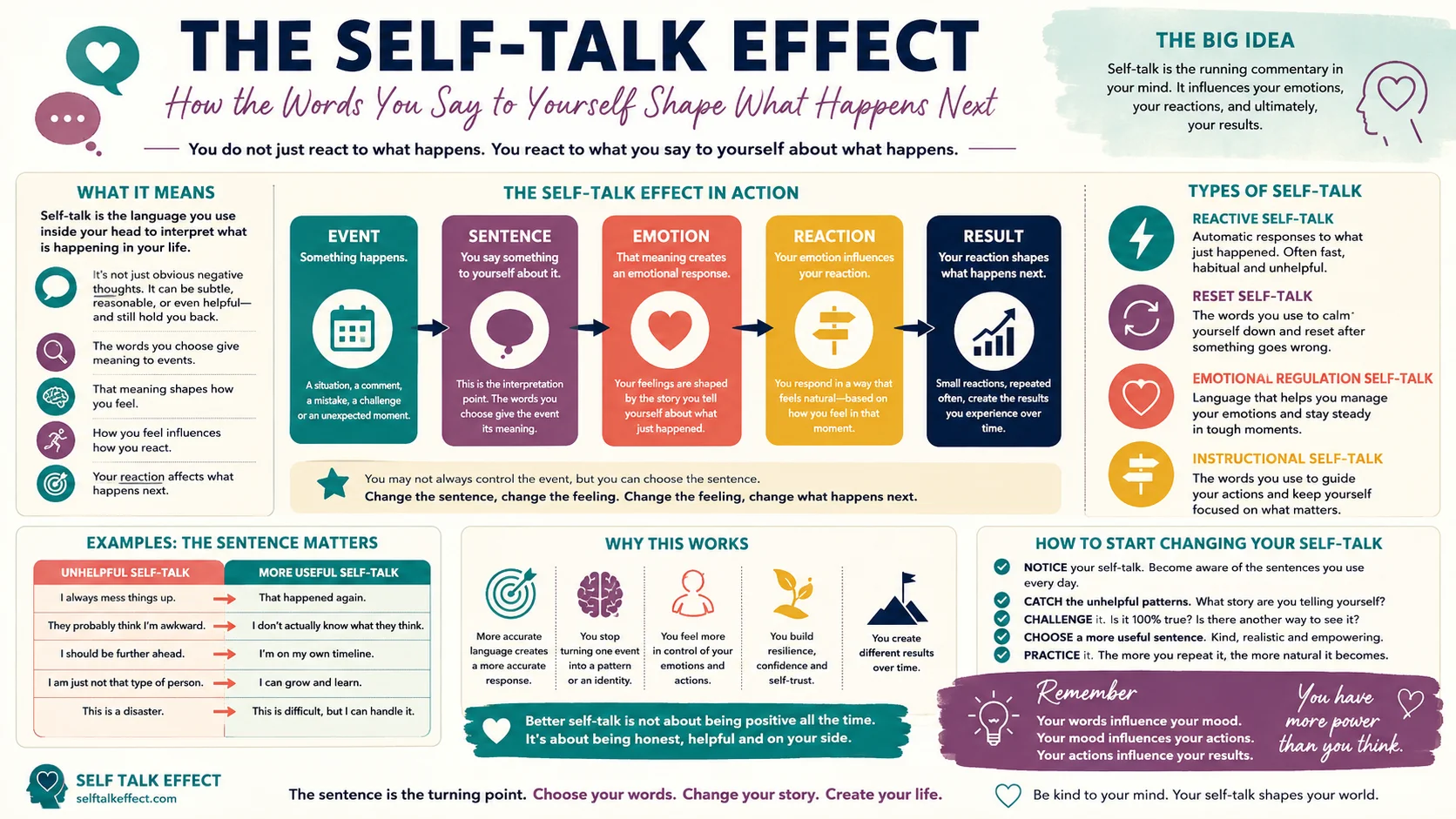
If that happens to you, maybe you, like me, believe the event itself caused the way you feel but there is often something that happens in between. You say something to yourself about the actual event and what just happened. Maybe you say: "I always do this."   "I always get things wrong."  "This is going to be a disaster."  "I can't handle this"

It is THAT sentence, right there, in that moment that can change the meaning of the situation, and once the meaning changes so can your emotional response.

This site is owned and operated by Inspirational Guidance and created by Diane Corriette a certified coach, NLP Master Practitioner, and someone who has spent decades studying how the mind shapes the way we live. The guides, workbooks, and frameworks here are built from that research and from real and lived experience - not theory. Every tool is designed to be used, not just read. About Self-Talk

What Is Self-Talk?

Self-talk is the language you use internally to interpret what is happening in your life.

It is not only the obvious statements like "I am a failure" or "I can't do anything right", negative self-talk is often much more subtle. It can sound reasonable, responsible or simply like an ordinary observation.

"I should be further ahead" - turns comparison into pressure
"This is a disaster" - turns an unpleasant even into something much bigger
"I always mess things up" - turns one event into a pattern.

These words matter because they influence the meaning you attach to the situation. This is the Self-Talk Effect. 

"Sometimes changing what happens next starts with changing what you say to yourself about what just happened"
- Self-Talk Effect

The Steps

Step 1

The Sentence Running Your Behavior

Do you even recognize the sentence running your behavior? That's the first step towards managing your negative self-talk

Find out more
Step 2

Your Mood Isn't Random

Once you understand the sentence running your behavior you can look at how it dictates what mood you are in.

Find Out More
Step 3

Interrupt The Spiral

You understand the sentence. You acknowledge it changes your mood now how do you help yourself choose a different sentence?

Find Out More
how negative self-talk affects our life

EVENT → SENTENCE → EMOTION → REACTION

The event happens. The sentence interprets it. The emotion follows that interpretation. Your reaction then follows the emotion.

That means the sentence is an important point of intervention. You may not be able to change the event, but you can learn to notice the language you use to explain the event to yourself.

If your language exaggerates what happened, your emotional reaction can become stronger. If your language turns one mistake into a conversation about who you are as a person, you may be less likely to try again. If your language assumes you know what another person thinks, you can react to an assumption as though it were fact.

The aim is not to force yourself to think positively or replace every difficult thought with an artificially cheerful one. It is to become aware of the sentences running through your mind, recognize what they are doing to your mood and how you feel and learn to make your self-talk more accurate, grounded and useful.

Look Closely At The Sentence

There is a reason we ask you to look more closely at the sentence you say to yourself.

If your language exaggerates what happened, your emotional reaction can become stronger.

If your language turns one mistake into a conversation about who you are as a person, you may be less likely to try again.

If your language assumes you know what another person thinks, you can react to an assumption as though it were fact.

If your language tells you that something is pointless, taking action can start to feel pointless too, but when you make the language more precise, the situation becomes easier to work with.
 

Featured Articles

From the Shop

Take Control Of Your Self-Talk

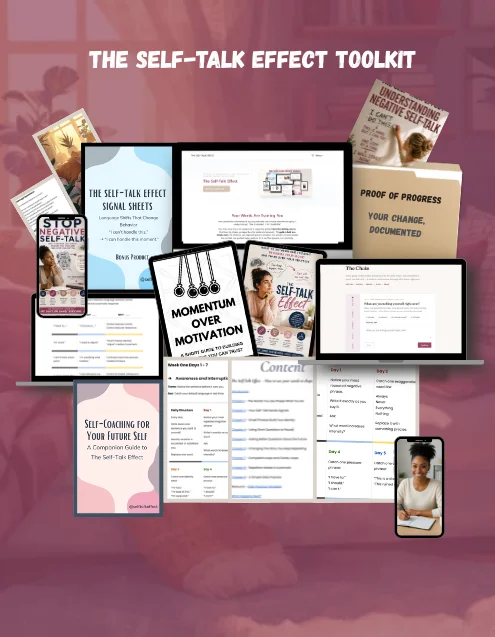
The Self-Talk Effect Toolkit Is A Practical System To Interrupt Negative Self-Talk And Take Control Of Your Reactions

This is not just a single guide. It is a complete self-talk practice system. Each resource works together to help you notice, adjust, and repeat better internal language until it becomes natural.

Get It Here →
Take Control Of Your Self-Talk Toolkit

Quick Answers to Common Questions

What Positive Self-Talk Can I Use After A Mistake

"This is behavior, not identity. I can fix it and keep going." Notice this separates what you did from who you are, which is what makes it usable in the moment instead of just comforting in theory. Read More

How Do I Stop Overthinking Everything?

Overthinking Is Rehearsed Interpretation Overthinking usually starts with a sentence. “That sounded stupid.” “They probably think I’m incompetent.” “I should have said something different.” “What if this goes badly?” That sentence creates discomfort. The mind then tries to solve the discomfort by analysing it repeatedly, but instead of creating clarity, it creates more noise. Read More

How do i take control of my self-talk?

If you want to learn how to take control of your self-talk this page will help you understand what self-talk really is, how it creates patterns you didn’t choose, and how to change it in practical, repeatable ways. Read More Here

How Do I Stop Negative Self-Talk That Happens All the Time?

Negative self-talk is a habit and a pattern and the good news is both habits and patterns can be changed or adjusted to reduce the impact that it has on your results and our life. Find out how

What Does You Become the Sentences You Repeat Mean?

Have you ever noticed how certain thoughts feel automatic and familiar? Say something often enough and it stops sounding like a description. It starts sounding like who you are. You get stronger at whatever you repeat. If you repeat a sentence regularly, it becomes familiar. Familiar becomes believable. Believable becomes automatic. Automatic becomes behavior. Read More

A Free Guide To Why Self-Talk Matters More Than You Think

When you begin hearing your self-talk more clearly, something important changes. You realize that the words inside your mind are not fixed facts. They are interpretations, and interpretations can be adjusted. That small adjustment can change your mood, your behaviour, and eventually your results.

Your words influence your mood.
Your mood influences your actions.
Your actions influence your results.

A Free Guide To Why Self-Talk Matters More Than You Think

An important distinction

You DO NOT just react to what happens... You react to what you say to yourself ABOUT what happens