Most people believe they procrastinate because they’re lazy. They snap because they’re stressed, or they avoid because they’re unmotivated. They think behavior comes first, but behavior is rarely the starting point. There is almost always a sentence that you say before the action or words show up.
You don’t just scroll for an hour. You say something first.
“I’ll just check this quickly.”
“It doesn’t matter.”
“I deserve a break.”
You don’t avoid the difficult conversation without commentary. You say:
“This will be awkward.”
“They’ll take it badly.”
“It’s not worth it.”
That sentence shapes what happens next. The trouble is, you don’t hear it because it runs quietly and feels reasonable. It feels like common sense. It feels like truth, and because it feels true, you don’t question it. That’s why you’ve never noticed it.
Why It Can Be Hard to Catch
Your inner dialogue doesn’t announce itself. It doesn’t say, “Attention: I am about to influence your behavior.” Instead it blends in and it sounds like you - because of course it is you but the difference is it's the you saying things out of habit rather than truth.
When you think, “I’m not ready,” it doesn’t feel like a story it feels accurate. When you think, “This always happens,” it feels like a conclusion you’ve earned.
But here’s the part most people miss: those sentences are interpretations, not facts and interpretations are built by our very human nature and need to label, predict and generalize.
If you repeat, “I always mess this up,” your behavior will eventually match it. Not because you’re incapable, but because you’ve rehearsed the identity.
You didn’t decide to become that version of yourself but what you did was accept the statement as fact (because you have evidence) and so you never stop to question the sentence. That changes today.
A Moment I Still Catch In Myself
Several years ago I was due to run a small workshop, and the night before, my stomach dropped. My sentence wasn’t “I’m nervous.” It was “I’ll just send them the notes instead, that’ll do.” Practical-sounding. Reasonable at 11pm. It was only when I said it out loud to someone else, and heard how thin it sounded, that I caught what was actually happening: I was about to avoid being in the room, and I’d built a sentence that made avoiding sound sensible.
So, what I did instead was change the sentence. I told myself “You've done harder things than this.” Those six words helped me relax and gave me the space I needed. That was enough to move forward and run the workshop.
Everyday Examples
Let’s make this simple. You sit down to work on something important. The sentence appears: “This is going to take forever.”
Notice what happens next.
Your energy drops. Your focus scatters. You feel resistance before you have even begun. The task hasn’t changed, but your interpretation has.
Another example. You walk into a room where you don’t know many people and say “This is awkward.”
Your shoulders tense. You hang back and don't say much during the event. After you leave you confirm just how awkward you are by saying “See? I’m just not good in groups.”
What is the common thread that ran the behavior? The sentence you said to yourself.
Here’s another one.
You make a mistake. “I’m so stupid.”
Now you feel smaller and maybe you hesitate next time or second-guess your decision. Eventually you say, “I lack confidence.”
Again, what ran the behavior? Not the event but the sentence you keep saying to yourself.
The Quiet Power of Ordinary Words
The reason this matters is because the sentences that run you aren’t dramatic, they are ordinary and many times they have come from years of convincing ourselves, through the events that happen in life, that they are true.
“It won’t work.”
“I’ll start Monday.”
“I’m tired.”
“It’s not the right time.”
None of these look dangerous and in fact they are perfectly sensible in what they are attempting to do but sensible, repeated often enough, becomes default behavior, and default behavior builds results. This is not about positive thinking your way into better self-talk. It’s about noticing how casually you narrate your own life.
If you keep telling yourself something is hard, overwhelming, pointless or embarrassing, your body reacts as if it is and it becomes your experience and limits what you believe is possible. You don’t need a major trauma to stay stuck. You just need a sentence you have never questioned.
How To Catch It
You can’t change a sentence you don’t hear. So start with this:
When you hesitate, pause.
When you feel resistance, pause.
When your energy drops suddenly, pause.
Then ask: “What did I just say to myself?”
Focus in on what you actually said and how it made you feel. Most people skip that step and they focus on the situation, but the situation isn’t what drives behavior. The meaning you give it does. You may not like what you hear at first and really that’s fine. You’re not judging it. You’re noticing it so you can begin to focus on saying something different.
Awareness isn’t dramatic. It’s quiet and it’s powerful, because once you hear the sentence clearly, it loses some of its grip. That's why the first chapter of The Self-Talk Effect isn’t about changing everything. It’s about building your awareness of what you say.
A Small Shift
You are looking to catch and change the sentence that by now may have become automatic behavior so give yourself the space and time to do this. As with most things in life consistency is key. A small shift might be something as simple as:
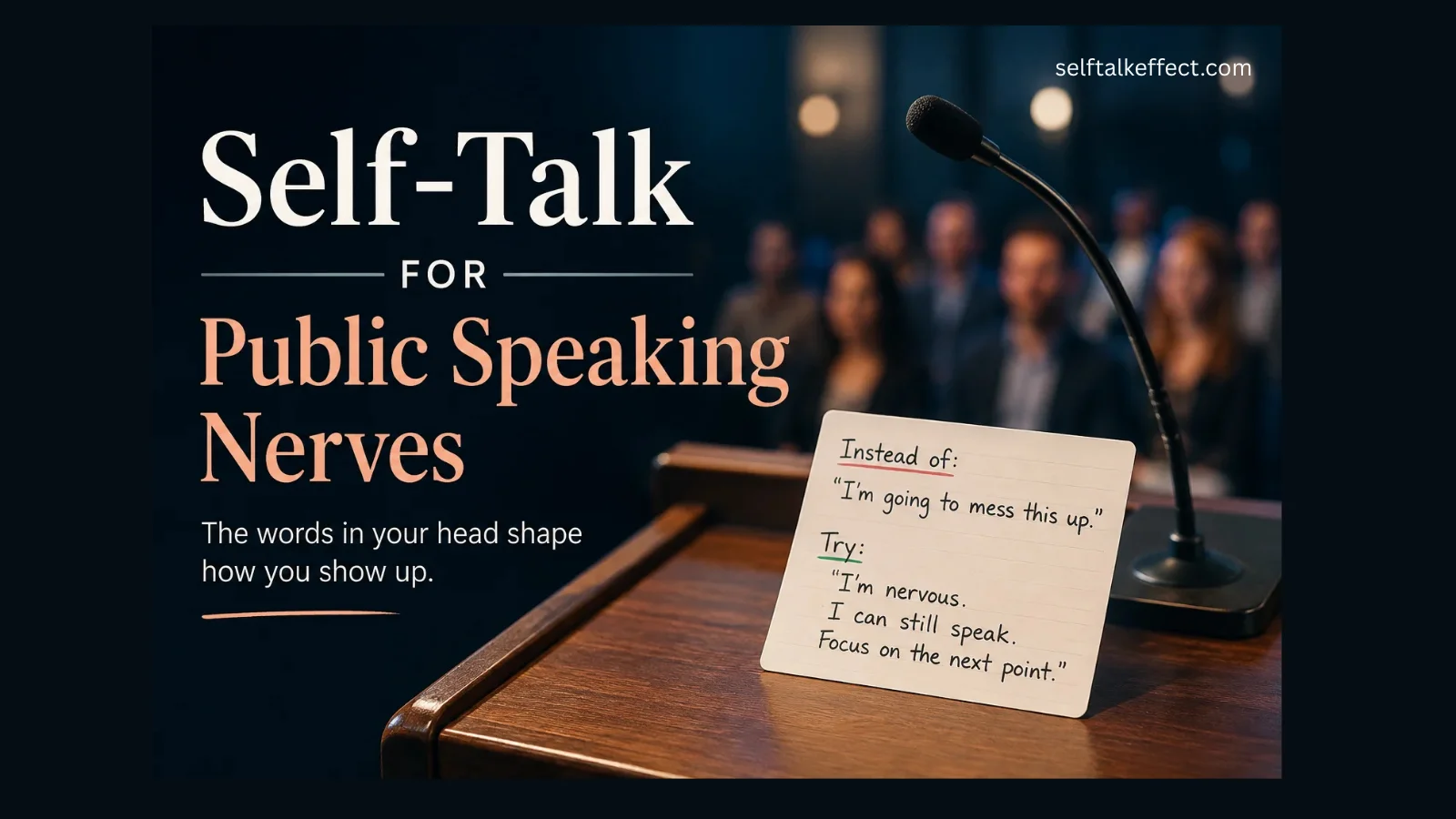
Instead of: “This is going to take forever.” You might say: “This will take some time.”
Instead of: “I’m bad at this.” You might say: “I’m still learning this.”
Do you notice the difference as you read those sentences? What difference does it make to you? Feeling it and acknowledging the change in how you feel will help you in finding your own patterns that you want to adjust.
The second sentence doesn’t inflate you and it doesn’t lie. It simply steadies the interpretation, and steadier interpretations lead to steadier actions. As I continually say in many of my articles our thoughts create our feelings, those feelings dictate our actions and our actions give us our results. If any part of that loop is interrupted by unhelpful self-talk it can lead to us not getting the results we hoped for in life.
Capture the Takeaway
Your behavior is rarely random and there is almost always a sentence before it. You don’t act and then explain. You explain and then act and the reason you haven’t noticed this is because the sentence feels like you. It feels automatic. It feels normal, but normal isn’t neutral. The words you repeat become the lens you see through, and that lens shapes what you do next.
Your Next Step
Today, don’t try to improve anything. Instead just listen and see if you can catch one sentence that appears before you hesitate, avoid, or overreact. Then write it down exactly as it shows up. Congratulations, that’s it and you now have the awareness you need to start making a change.
You need awareness first, because you can’t change what you haven’t noticed and once you notice the sentence running your behavior, you’re no longer on autopilot. You’re paying attention. If you found your self-talk just got a little quieter while reading this, imagine what happens when you work with it properly.
The Self-Talk Guide gives you the structure. Take a look → The Self-Talk Effect Bundle – your future self will appreciate it.