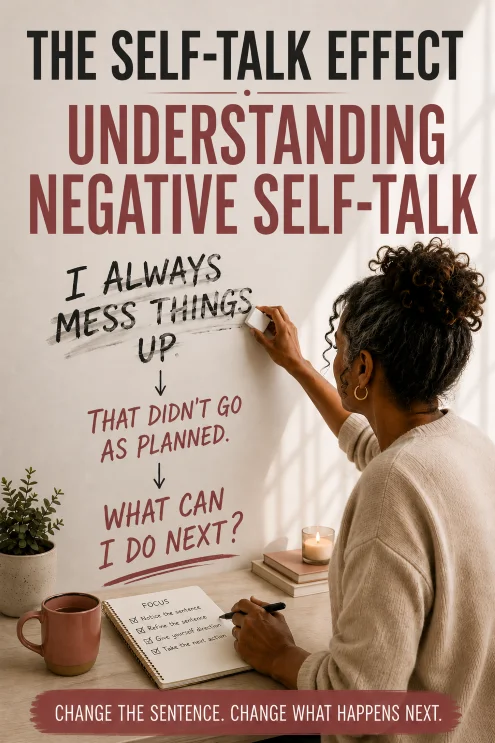
Understand Why Your Mind Escalates Situations
Negative self-talk often appears so quickly that it feels automatic.
A small mistake becomes "I've ruined everything."
A delayed reply becomes "They're ignoring me."
A challenge becomes "I can't deal with this."
In a few seconds the situation feels bigger, heavier and harder to handle.
The event didn't change. The sentence did. This guide shows you how that happens and how to interrupt it.
It isn't that you're too sensitive, or not trying hard enough. Most advice tells you to think positive and stops there — it never explains what's actually happening in the moment your mind escalates a small thing into a big one, so the same pattern keeps repeating.
I'm Diane — a certified life coach and NLP Master Practitioner. I spent most of my 20s and early 30s inside this exact pattern, and I built this guide from two decades of studying how language shapes emotion and behaviour, and from living it myself.
Not Just A Guide To Read
Alongside this guide, your account also includes Change the Sentence, a short interactive tool. You type in a real sentence you've caught yourself thinking, and it walks you through turning it into something calmer, one screen at a time.
And A Coach You Can Talk To
Your purchase also unlocks The Understanding Coach, a private AI coach trained on this guide. When your mind is escalating a real situation, open a chat, describe what's happening in your own words, and it helps you find the sentence underneath and a clearer way to word it. You get up to 50 messages across 60 days of access — a defined amount, not an unlimited subscription, with no ongoing fee.
The Pattern Behind Negative Self-Talk
Most people think the sequence looks like this: Event → Emotion → Reaction
But something important happens first: Event → Thought → Emotion → Action
The sentence you say to yourself explains what the situation means. If the sentence exaggerates the situation, your emotions escalate. If the sentence stays clear and accurate, your reaction stays steady. That sentence is the smallest point where you can change direction.
Here's What Happens Once You Open This Guide
You'll work through four simple steps:
- Notice the sentence
- Refine the sentence
- Give yourself direction
- Take the next action
The Change the Sentence tool runs exactly these four steps on screen, with your own sentence, so you're not just reading the method — you're doing it.
Small wording changes often reduce emotional intensity. When emotional intensity drops, clear thinking returns. And when clear thinking returns, better action becomes possible.
What Changes When You Understand This
Once you understand the mechanism behind negative self-talk, something important shifts. You begin to notice the moment your mind escalates a situation. Instead of reacting automatically, you can pause and adjust the sentence.
After reading this guide, many readers begin to think: "I know how to change the sentence when my mind escalates."
Left alone, that inner sentence keeps deciding your reactions for you, one escalated moment at a time. That awareness becomes the starting point for everything else in the system.
Who This Guide Is For
This guide is for people who notice their mind sometimes escalates situations. People who:
- replay conversations in their head
- assume the worst too quickly
- turn small mistakes into bigger stories
- feel emotions rise before they know why
You don't need complex psychology to understand this process. You simply need to see the pattern. If you recognise yourself in that list, this guide is a good place to start.
Meet The Understanding Coach
Reading explains the pattern. Talking it through is often what makes it click for your own situation. Whenever a real moment starts to feel bigger than it is, open the coach and tell it what's going on in plain language. You can ask it things like:
• "Here is the sentence I keep repeating, what is underneath it?"
• "Why does this small thing feel so heavy?"
• "Help me reword this so it stops escalating."
What You're Getting
• The Understanding Negative Self-Talk guide
• Change the Sentence, the interactive tool
• The Understanding Coach, 50 messages across 60 days
A Fair & Honest Refund Policy
Because The Self-Talk Effect: Understanding Negative Self-Talk is a digital download, it is instantly yours when you purchase. That means it is easy to download, keep, and request a refund. For that reason, refunds are not issued once the system shows your product has been downloaded. If you haven't downloaded the product or really think you deserve a refund please contact us via your dashboard support area and let us know, each refund will be assessed on an individual basis and we'll make it right if we need to do so.
Start Interrupting Negative Self-Talk
Negative self-talk doesn't disappear by force. It changes when you understand how it works. Once you see the sentence clearly, you can start changing it.
Questions & Answers
What's actually inside this guide?
The guide itself, the interactive Change the Sentence tool, and access to the Understanding Coach, a private AI coach trained on this material.
How is this different from generic positive thinking advice?
It explains the actual pattern behind escalating self-talk, event, then thought, then emotion, then action, instead of telling you to simply think positive.
What is Change the Sentence?
A short interactive tool where you type in a real sentence you caught yourself thinking, and it walks you through turning it into something calmer, one screen at a time.
What is the Understanding Coach and how many messages do I get?
A private AI coach trained on this guide. You get up to 50 messages across 60 days, a defined amount rather than an ongoing subscription.
Do I need any background in psychology to use this?
No. This is for anyone who notices their mind escalates small situations, replays conversations, or turns mistakes into bigger stories, not just people who have studied the topic.
What's your refund policy?
Because it's an instant digital download, refunds aren't issued once the product has been downloaded. If you haven't downloaded it or believe you deserve a refund, contact support through your dashboard and each request is assessed individually.